Bliss.

Bliss.

Sunday, February 3, 2019

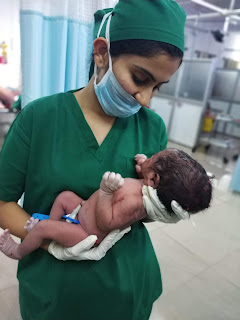
Observations in OBG: The joy of bringing babies to life!

As always, with a hint of excitement and ladles of nervousness, we reported to the Department of Obstetrics and Gynaecology just about two months ago. As we were shuffled into the 3 units A, B and C (each withits own unique reputation), Labour room and Casualty, some had Lady Luck on their side while some others knew they had a few more hurdles to cross than the rest.

The Department is one of the busiest at HIMS, notorious for its hectic schedule which reflected upon the interns and staff alike. I was posted in B Unit which initially had the all-male staff of Dr. Rajashekhar Sir (Unit Chief), Dr. Shridhar Sir and Dr. Raghupathi Sir. Later Dr. Nishitha ma'am joined the Unit. On my first OPD day, I learnt the main steps of taking and ANC case including the examination. Now these were things that I could learn well only with time so initially it would take me some time to localize the Fetal Heart Sound (FHS) but slowly, over the weeks, my ears began to get trained to recognize the familiar rhythmic beating, to make an estimate of the gestational age by the abdominal examination and also to assess about the progression of labour based on the PV examination.

A typical duty day involved a quick prerounds of the Post Natal Wards, Immediate and Late Post Operative Wards, Special Ward, ICU and Gynaec Wards after which we had the ANC rounds with the staff and the rounds and follow up of all of the wards as advised by the professors during their rounds. After this we hurried to the ANC OPD to clear the cases and give admission to those in labour. Any emergency case would be taken up for LSCS once all the investigations were in place. By 4PM, there would be rounds by the duty doctor of all the ANC cases admitted during which he/she would decide the course of action: Watch for Progress/ Shift to Labor Room/ Prepare for LSCS or maybe even discharge in case they were not in active labor.

Following this was the tedious process of writing the case sheet (which was later marginally simplified by a book which we had to fill up) looking at any loopholes, any deranged laboratory values or medical / surgical comorbidities. Usually there would be few cases taken up for Emergency LSCS where we were required to assist and close up. The common indications were Meconium Stained Liqour with Foetal Distress, Cephalopelvic Disproportion, Previous LSCS, AntePartum haemorrhage, Pregnancy Induced Hypertension(PIH), Abnormal Lie/Presentation among others. Along with the usual ANC cases, there were several cases of spontaneous/ threatened/ missed abortion or cases who came for MTP or HIV/HbsAg positive which were dealt with in the Septic Labor Room. Cases required strict monitoring of vitals were shifted to the High Dependency Unit (HDU) where PIH, Ecclampsia, Pre eclampsia and GDM cases were monitored by the labor room interns and staff.

One notable incident that occurred when on duty was the case of the 'Tubectomy Meningitis' as I'd like to call it. Two patients who had been operated earlier in the morning, developed restlessness and became disoriented later in the evening even as their vitals remained normal and their laboratory investigations revealed no obvious imbalance. While we monitored the patients all night long in the ICU, the patient attenders were increasingly impatient and we even had to deal with the mob and media attention. They were referred to NIMHANS the following morning where they were said to have 'Bupivacaine Induced Aseptic Meningitis'. Now the patients made a complete recovery but it brought about a lot of changes in the OT and the Post Operative Care of the patient to prevent such instances.

What began with hesitation and reluctance towards this subject gradually changed into respect for this demanding yet equally fulfilling career choice. From the first LSCS assisted to the first baby delivered via normal vaginal delivery, there was a definite surge in my interest and respect towards this department. From bullying irresponsible and intoxicated patient attenders to arrange for blood for their anaemic patient in labour to holding the hand of the sobbing woman who had just had an IUD (intrauterine death) in her first pregnancy, there was something to learn in everyday of OBG.

The Gynaec Ward had its own set of patients who needed to be operated upon for commonly a Fibroid Uterus or  a Uterovaginal Prolapse but I also got to see a gigantic mucinous cystadenoma of Ovary in an otherwise frail woman of 70years operated upon successfully. There were plenty of ruptured ectopic that came our way, especially on the C unit duty days but as Dr. R said it, a "quick in, quick out" approach works best to handle these cases. Be it with the interaction with patients or their attenders or sometimes with the professors, nursing staff and even our colleagues, there has been some real high voltage drama we've witnessed/been a part of.

Towards the end of two months, I did feel relieved that it had passed with no major mishap but more importantly, I also felt like I was actually doing something. Perhaps the posting where I definitely had *some* relevance to the Department even though we were mostly treated otherwise. :')

Labour Room with the Roomie!

Of course, the completion did not pan out as expected and it definitely was a disappointment but nevertheless, irrespective of the outcome of my derailed completion/erroneous extension I will be thankful for everything I have learnt from the professors and nursing staff during my 2 month stint in the Department of Obstetrics and Gynaecology at SCH, Hassan.

Friday, November 16, 2018

Unfulfilled Dreams.

Little ones who did not see the light of the day,
From tiny undefined forms in gray,
To well formed twins in full bloom,
Sat snugly encased in their mother's womb.

For nine long months, she waited with bated breath,
As weeks turned into months, the belly swelled
In hopes of pink and blue, the young mother dwelled,
Alas, she only saw them after their death.

Young and naive, she felt their plea for help,
Day after day, she heard their beating hearts aloud,
She pleaded in vain for them to emerge from her womb,
But alas, she would only see them entwined at their tomb.

In the memory of the unborn twins of S, who could have lived.

Sunday, November 4, 2018

The Lessons and Learning in Medicine (2)


As the days wore on, we had an established pattern among ourselves to divide the duties. Of course, there were differences of opinion but somehow we managed to work it out in the better interest of the patients. There was no time to hold on to any disappointments because on duty day, you are always on your toes! A particularly fond memory I will hold is of finishing the rounds and catching up with Sanjana C, my co intern over the cases and how their treatment was progressing.


Rounds with each professor was a different experience. While some looked at the investigations to have a clear-cut evidence to their probable diagnosis, others relied on clinical features to base their treatment. While some discussed rare or important diagnostic features and 'never to miss features', others preferred to leave it open ended with questions to ponder over and get back rather than supply the answers themselves. On the whole, rounds was when we had an idea how each consultant would approach the same case and thus develop our own blueprint.

Thank you Sir :)
There was Sahana, the 19 year old who has been a puzzle I couldn't figure out. She came with icterus, h/o fever and passing high coloured urine and bilateral pedal edema and her Liver Function Test was completely deranged. She tested negative for Hepatitis B and Hepatitis C and her USG abdomen showed mild ascites and pleural effusion and her CT scan correlated with this. While her pedal edema decreased during the course of her stay in the hospital, her LFT did not show any improvement and hence her icterus remained.

Being a government set up and the festive season, the test reports for Leptospirosis and Hepatitis A were postponed and we had to discharge the patient and review with the reports. I did not have much hope of seeing her again but imagine my surprise and relief when I received a call (I still have no idea how her mother caught hold of my number) from her regarding her reports nearly a week after her discharge. We finally had a diagnosis! What I had suggested to the professor (after seeing in the Micro Lab that they carried out these investigations) actually turned out to be a valid diagnosis. She finally had a diagnosis! Hepatitis A it is and she was asked to review on a monthly basis with LFTs.

There was the patient with massive pleural effusion and my co intern and I did a pleural tap which yielded a straw coloured pleural fluid which on analysis had high levels of ADA (Adenosine DeAminase) which is an enzyme elevated in Tuberculosis.

Then there were the suspected cases of H1N1 which required early detection and intervention to prevent fatality. There had been a few suspected cases which went undetected and they had succumbed to secondary bacterial infection which ultimately led to respiratory failure. The protocol involves isolation of the patient in a separate ward, taking a throat swab and sending it in the VIM container to the DHO office who would then courier it to the Viral Research Centre of KMC, Manipal. The patient is usually started on 2nd line (failing which, 3rd line) antibiotics along with the antiviral Tamiflu  (Oseltamivir 75mg) and continuous nebulization and O2 inhalation. There have also been a few cases which were recognized early and treated accordingly even without the throat swab reports since that had been getting delayed.

Just when I had begun to regret how I had not performed an ascitic tap in the course of my medicine posting came a case on our Pre Duty day of Cirrhosis with gross ascites. As is the procedure we start the patient on appropriate medication to increase the fluid loss and also perform 'paracentesis' to drain the excess fluid from the abdomen which may be from 1-2L at a time. Unfortunately, the primary diagnosis of Myxoedema Coma couldn't be treated in time and she did not make it.

There are some moments when you know that under different circumstances, your patient would have survived; be it the young man with a haemorrhagic stroke who was referred back from NIMHANS who developed further complications and had massive internal bleeding and succumbed to it or the other young patient, again referred from NIMHANS for myoradiculoneuropathy and dysautonomia who was on ventilator support after he was here and had renal failure in a matter of time and he had a cardiac arrest soon after. There are several limitations in the set up so you know you are bound by those restrictions but it is the ones who can make it with the existing facilities who must not be missed!

Towards the end of my posting, I also had an experience of 'Protocol Duty' which is basically a duty doctor being available at all times to any
Politically Important Person (PIP) like the CM or the Ex PM or a certain MLA who were on a visit to the district. While it was mostly uneventful and spent in the sweltering heat of the ambulance understanding how bureaucracy works, it also gave an opportunity to visit the Hassanamba Temple which thronged by visitors when it is opened for a few days in the year.


But it was the last day which truly lived up to the intensity of Medicine duty with several MIs, CKDs and poisoning cases, several cases collapsed and some were resuscitated against odds. It was a truly memorable duty and at one point it was a matter of shunting from the ICU to the ICCU as there were alternate calls from either places.


Medicine had its highs and lows with moments of elation at a diagnosis made at the right time or a procedure that went well or a patient recovering well or even an attender recognizing your small contribution in the recovery of the patient. There were moments when you were frustrated by the delays in the system, the unavailability of even the simplest of medicines by government supply, the brash behavior of the patient attenders and sometimes their complete ignorance and lack of interest in the patient despite their deteriorating health. And then there were better moments when you see your patient successfully weaned out of the ventilator and wave you a goodbye after a prolonged stay. There are patients attenders who are thankful for the visible change in their patient or atleast for the efforts made towards their recovery. There were those who gave in every bit of their time and effort to see their patient turn over a new leaf and it was always a pleasure to interact with such folks.


All in all, Medicine was exciting and terrifying despite the patient load. It might have been physically and emotionally draining (when you realize you have been declaring deaths on such a regular basis, a sudden wave of emotion hits you over the fact that he/she is more than just their vital stats which is all you know about them.) But it offered a wonderful learning experience from the management of common cases to performing the basic procedures in the casualty, wards and ICU. From having the fear of facing the patient for not knowing what to do to approaching the patient to assess the vitals, starting the immediate treatment with a possible diagnosis in mind to explaining the prognosis of the patient to their attenders, it has been quite an eventful journey with some of the best cointerns and professors I could ask for.

With trepidation and excitement, I set foot into OBG, my home for the next two months. Here's hoping for new adventures :)


Tuesday, October 30, 2018

Anecdotes from the Medicine Wards... (1)


With much trepidation about the big majors I set foot in Medicine and my first consolation was that I was shunted to Psychiatry for the first 15 days. So I had 9 to 4 psychiatry duty followed by Medicine duty in the casualty on OPD days. A big relief was that I was placed in Medicine D Unit which had professors who were friendly and ready to share their knowledge. I was indeed lucky to have skipped the units with a cranky or an unsympathetic professor.

Though my time in the casualty was restricted to the post OPD hours, there was plenty of work since the cases simply never stopped coming! From accelerated hypertension cases (a cool 240/110mmHg), uncontrolled T2DM, chest pain, acute GE, CVA, fever with chills to alcoholic liver disease, alcohol withdrawal and the ever so common poisoning and snake bite cases, there were an abundance of cases that were constantly rolled into the casualty often giving us not even a moment's respite because there would also be calls from the wards/ICU/ICCU/Emergency regarding any patient who would need immediate attention.

In short, even though we were 4 interns in the unit, the workload managed to keep us on our toes at all times.

Dr. Hoysala, Dr. Muthuraj Sir, Dr. Halesh Sir, Dr. Impana and Dr. Sanjana C (missing in action : Dr. Venkatesh Sir)

An interesting case would be of Aravamma who came with classical chest pain, referred from a smaller government hospital (Belur?) after the ECG there showed what appeared to be Ventricular Tachycardia and her BP was around 180/100mmHg. Her previous history suggested IHD and she had undergone angioplasty earlier. Presently she needed immediate treatment in an ICU facility and since we had one bed vacant at that time, we explained the risks, the prognosis and admitted the patient. 


We started her on Amiodarone (an antiarrhythmic) at 150mg (1amp) in 100mL of NS over 10mins but she still remained tachycardic (180bpm) so we had to give her a DC Shock and the change in her heart rate was evident immediately. It was a scene reminiscent of a sitcom when I held the paddles (thanks to the guidance of Halesh Sir who gave me the opportunity) and the familiar 'charge' and 'clear' was announced. Although she remained critical after the initial recovery and she had to be referred to Jayadeva Institute, it was a memorable moment that made a lot of difference.

Then there was Gowramma who was admitted for chest pain and pain abdomen under Medicine but collapsed after her pain abdomen which required a CT scan went unattended. In retrospect it appeared to be an intestinal perforation which should have never been admitted under Medicine but under Surgery where she might have had some chance.

In contrast there was another patient who had chest pain and pain abdomen. While we had an ECG and Troponin I to rule out IHD, it was the CT Abdomen which suggested metastatic growth in the liver hence she had to referred to a higher centre even though she appeared to  be stable.

There  was Rangegowda who was a known case of IHD and had a poor prognosis and when he had a second arrest, by the time the ECG taken reached us and by the time it was seen by the duty doctor, he had suffered another arrest and couldn't make it.

Then there was Jayalakshmi who came with bleeding gums and her inital platelet count was around 500/uL. She received about 6 pints of whole blood transfusion for her anaemia and thrombocytopenia but her last platelet count was around 28,000/uL.

After a peripheral smear, the next logical step was a bone marrow biopsy to investigate the cause of thrombocytopenia. After some running around, I coordinated with the Pathology professor who taught me how to do a bone marrow biopsy with a Jamshedi Needle at the sternum. We had a look under the microscope and it appeared to be a case of ITP so we put her on oral steroids (Wysolone) and discharged her after nearly 10 days of admission.

There were a lot of patients who came in with genuine complaints and were admitted only to have no investigation done and were only visited occasionally by their attenders who viewed them more as a burden and hence didn't bother to get the necessary blood transfusion done or even get them the medicines prescribed. Another patient who had severe pitting edema of upper and lower limbs needed a 2D Echo because her ECG suggested a previous MI but it took an angry phone call from my side explaining the seriousness of the old lady's situation to get the absconding attenders who were away due to festivities.

It was disappointing to see how little some attenders cared and at the same time there were exceptions like the 13 year old boy who got his grandmother Arjunamma admitted for fever and anaemia and ensured that she got 2 pints of blood transfusion and a USG Abdomen done and had been the main cause of her good progress and successful recovery.

There was Thayamma who came with weakness of Right Upper and Lower Limb and the CT Reports confirmed the stroke but it was the CBC which caught my eye with an elevated WBC count (149*10e3/uL) and a Peripheral Smear confirmed the probable diagnosis of Chronic Myeloid Leukemia. Unfortunately, even after we explained the need for a bone marrow biopsy and the availability of the appropriate treatment at Kidwai Institute, the attenders and the patient were inclined to go home so there wasn't much we could do.

Probably one of the most heart-rending cases are those of 'Unknown' patients/destitutes who have literally been picked up from the streets after some passerby would have informed the ambulance hotline. Since they had no attenders, it was left to the hospital staff to get the investigations done, ensure her nutrition, hygiene and well being. The sad reality is, when one is not accountable, the entire team begins to take less effort because they know they are not answerable to anyone. 

The (unknown) old woman who was brought in an inebriated state only mentioned vaguely that she had been assaulted by her son while slipping in and out of her delirium and so gangrenous foot required a doppler according to the surgeons who didn't offer any other treatment, the fractured forearm couldn't be put into a slab because of the swelling according to the orthopaedics, her sugars were elevated but there was no Insulin supply in the ward, her Urea and Creatinine were elevated but with all other comorbidities, she certainly wasn't a candidate for dialysis and thus ended the story of a woman neglected by her own kith and kin and subsequently by society as well....

(To be continued)
https://moodymusings95.blogspot.com/2018/11/the-lessons-and-learning-in-medicine-2.html?m=1

 (some names may have been changed)

Thursday, September 20, 2018

Healing The Maladies Of The Mind.


Old couples who had warmth and love despite the illness of the other,

Newly weds who looked at each other with fresh excitement but had deep seated issues,

Middle aged men and women who came alone in awareness of their condition,

Little ones who buzzed around with abnormal activity,

Young men who had fallen prey to addictions or who had been betrayed by relationships,

Women who survived the torment in their families but were victims of an innate sorrow,

Old men who had spent their twilight years in a liquid trance and were now facing the consequences,

People of all ages from a 11 year old boy bullied at school to a middle aged mother tormented by obsessions beyond her control, who had taken the extreme step to end their miseries as a lasting solution.

They were all patients in the Department of Psychiatry where I have been posted for 15 days.

I didn't have a lot of expectations since this was a busy government set up with limited facilities but as the days progressed by views were altered to some extent. We had admissions in the Male and Female Psychiatry Ward, follow up of references from the new hospital wing, OPD duties and also ECTs given twice or thrice a week while there are EEG facilities at a low cost, a small vocational activities centre and programs held in view of Mental Health Awareness.

We had a program in view on suicide prevention where we had a few cultural events, poetry and paintings were on display and we were given saplings to mark the event. during the past fortnight there was much to be learnt from Dr. P who was known for giving time to patients and counseling them and also looking into other comorbidities, Dr. B who has been in the hospital for almost a decade now and hence has an established rapport with her patients and Dr. S who always made it a point to explain the scientific basis of the illness to the patient and the attenders and also tried to implement aspects of cognitive behaviour therapy along with medication.

There were patients being seen by the Prof for since 6-7 years, patients who had shown tremendous improvement with medication and those who remained in the same level of (dys)function inspite of regular medication. Commonly, there were cases of Alcohol Withdrawal Syndrome, Generalized Anxiety Disorder, Major Depressive Disorder, Bipolar Affective Disorder (Mania), Catatonia, Obsessive Compulsive Disorder and undifferentiated Schizophrenia among others in the wards. The patients were monitored with respect to their medication and many left the premises close to their premorbid personality while some, like Y had to be discharged against medical advice (DAMA) since his religious inclinations had increased and he began to demand to go home. L was a typical case of schizophrenia with bizzare delusions, thematic perseverence and formal thought disorder even as he was oriented to time, place and person. During my ward duties for 5-6 days, the patients became somewhat more cheerful during the evening, some would even joke and manage a smile during my post dinner rounds while for some, the dreaded night only spelt restlessness and craving for liqour.

The OPD sees quite a consistent turnout of patients everyday with a minimum of 20-30 new cases and another 30-40 coming for medications or follow up. Commonly the cases were of dysthymia and MDD in middle aged women, adjustment disorder or sometimes bipolar affective disorder in younger women, generalized anxiety disorder in middle aged males, social anxiety in younger males, alcohol dependence syndrome in males (and even nicotine dependence syndrome) of all ages,
Attention Deficit Hyperactivity Disorder in children and cases of dementia in the older age group.

During my interaction with the patients (we were to take the patient history, vitals and present before the Professor who would then look into the treatment and counselling aspect), I realized that it requires some effort to dissociate the family conflicts, financial crisis or relationship failures (i.e the psychosocial stressor) from the actually illness of the patient. I felt that to a large extent, the individual's symptoms can be improved with treatment but when the stressors persist, it is nearly impossible to guarantee a significant change in the quality of their life. However, while we cannot instruct them on how to lead their life, we can always give our suggestions or better yet, help them to cope with their circumstances with courage and endurance.

The most important skill in this department is listening. While in most other departments, a preliminary examination and relevant history elicited to establish the timeline guarantees a probable diagnosis and treatment, in this case it is more of gently unearthing the relevant facts from the mound of unnecessary detail from not so forthcoming patients until they are ready to share the persecutory thoughts plaguing their mind. Only then can you consider a diagnosis or a sometimes a mixed episode after which you look at other comorbidities and decide on the suitable drugs.


Another indispensable quality is that of empathy. You cannot help your patient of you cannot try and understand how they are feeling. True, you and I know that the voices they are hearing in their head are not real but you need to make your patient feel that they are not alone in their suffering. You will need to educate them that they are not ill fated to feel such strong obsessions or deep seated feeling of sorrow, it is after all an imbalance of neurochemicals like seratonin and dopamine which can be controlled with timely and appropriate medication, support from their family and regular follow up.

Saturday, September 8, 2018

Lead Kindly Light.

From mounting debts that pushed them off the edge
Through affairs that drove an irreparable wedge,
To the grieving for whom relief was a far fetch,
They chose the untrodden path of no return.

While somewhere a wife grieved for her beloved
Elsewhere a lover regretted hasty words unapproved.
And yet another father repented over love unshowered,
For they had lost a loved one to a preventable illness.

Tender care and concern was what they needed
To nudge the fallen spirits that could be reignited
A warm kindling fire of support was all they pleaded,
To awaken the sanguine Phoenix from their ashes.

To save one from the clutches of despair,
Is akin to saving a drowning man at sea.
By giving wings to a wounded man's dream,
Be that social pillar that shall heal and repair.


Suicide is not the answer.
Written in view of Suicide Prevention Awareness.


Tuesday, September 4, 2018

Keep your eyes and ears open!


Here we are at the end of August with 2 months of Medicine looming large. The past month has been spent in the Ophthalmology department and presently in the Department of ENT.

Ophthalmology department worked very systematically and since there were PGs here, there were specific tasks allocated to the interns. We did a LOT of IOP measuring, VT measuring, Lacrimal syringing, conjunctival washes and seeing the OPD cases upto one extent following which the PGs would take over. We even had a seminar assigned to us on a specific topic and thankfully that went without a hiccup. 

The Department is extremely productive; there are OTs almost thrice a week with one of them being a 'Camp OT' where more than a dozen patients would come for the cataract surgery. Apart from the regular cataract surgeries, Pterygium excisions, dacryocystectomy and Trabeculectomy procedures, there was the speciality clinic where they did laser procedures for Posterior Capsule Opacities (PCO: a common post op complication), Testing of Visual Field by the Automated Perimeter, B Scan (when the fundus was not well visualized on Direct Ophthalmoscope) and Fundus Fluorescein Angiography in cases of Diabetic Retinopathy and CRVO and so on.


While some days were interesting with something new presenting in the OPD like a Corneal Ulcer or Nystagmus or perhaps a foreign body, other days were spent in the mundane reality of testing the IOP of patients who simply refused to follow my instructions in spite of the simplest of explanation in the most controlled calm voice possible. Ophthalm duty did not actually involve frequent casualty calls and even when they did, there would be a first year PG to help you with it. The PGs were friendly and the kind you could approach for all the questions that pop into your head.

Following 13 days in Ophthalm (I took two days off and headed home for the weekend. Ah, bliss.), It was time for ENT. The ENT OPD was definitely busy and there were regular admissions for the surgical procedures like Tonsillectomy, Septoplasty under FESS, hemithyroidectomy, Excision of swellings, Tympanoplasty with Mastoidectomy and sometimes even emergency tracheostomies.

 The OT is twice a week so more often than not, due to the heavy load of cases, a patient ended up having his surgery after it had been postponed ATLEAST once. After a 'shakeup' of things regarding the casualty duties, it appeared that we would not have to do duties but of course that was not meant to be so the duties are back on and we keep the PGs in the loop.


While ENT does bring you in close contact with infections, it also brought out the effect of people's habits. Oral submucosal fibrosis was a common presentation after years of tobacco chewing as was a carcinoma of pyriform fossa or a tonsillar malignancy in chronic smokers. One patient came to us with a very obvious swelling in the neck that ulcerated in few days, change in voice, inability to swallow and in stridor requiring a tracheostomy within a few days. While some of the early stage cancers are given RT/CT, the others are given more of palliative care since they would not be eligible for radical neck dissection and RT due to the  widespread growth of the tumour.

Another patient I followed up was Eshwaraiyya who came to us with uncontrolled epistaxis. He had earlier undergone ligation of the sphenopalatine artery at St. John's as well but the problem had reared its ugly head again. He had a history of cerebrovascular accident few years ago and was on ecosprin since then. He was also a known case of hypertension and had been passing blood in stools for some time now which had caused his Hb to drop to alarming levels of 5gm/dL. After transfusion of 3 pints of blood his Hb improved but that didn't solve the root of the problem so we referred him to the surgery department where they scheduled him for a colonoscopy to find out what could be causing the bleeding.

ENT was a memorable posting thanks to the interaction we had. Some of the professors were friendly and explained more on the procedure and the case at hand, the PGs were approachable and I was excited to find a fellow bibliophile in Sana ma'am and also, it was good to have more interns join us making the work load lighter, fun times more frequent and many light hearted moments during the course of these 15 days!


The next 6 months are the 3 big majors starting up with General Medicine which includes 15 days of psychiatry. I have a lot of trepidation about the coming days but hopefully they will be eased once I get into the thick of action. Here's hoping I can do my best, deliver to the best of the facilities available and assimilate as much as possible from my experiences. :)

Thursday, August 23, 2018

Roars To Silence.


A formidable figure in the past,
Among others he stood tall and strong,
With a commanding presence that would last
He marched to the tune of his own song.

Against odds he rose to a eminent stature,
For years he was at the coveted pinnacle
A man revered and feared for formidable nature
His baritone created ripples along the rural folk.

But Fate moved the dice one fine day,
For none can forever keep illness at bay,
And thus began the decline towards doomsday
Ravaged by the insidious tumour, he would sway.

Alas it was a cruel trick upon him,
As his deep voice hollowed into a ghostly whisper
And his frame melted Into bony nothingness,
His dignity was shredded forever.

His spirit battled against his frail frame,
As he accepted his inelegant mortality,
His lost glory he could not reclaim
Yet with stoic grace he walked to his finality.


To the 80+ old man with a Carcinoma Larynx. He can't talk. The tumour has invaded his pharynx as well. So he can't swallow either so he needs a jejunostomy. He is shrunken and shrivelled up and his eyes are hollow. More than that it's the feeling of helplessness that he can't control the drooling and cant express anything verbally. You begin to wonder that when someone says they are 'alive' there are different degrees of being alive and this is also one kind of living.

On further interaction with the patient's attenders, I gathered that he worked as a revenue officer across the state and that he was a well read man. I saw for myself when I received a note in English from the patient for a complaint he had. :)

Sunday, August 12, 2018

The month of Electives at HIMS

After a month of Orthopaedics began my stint as the CMO. The CMO chair is definitely the "hot seat" as he/she has the overall responsibilities of MLCs as well as to look into every case and start initial treatment and ensure the concerned intern attends to the case. Along with this, the CMO has to look into the brought dead cases and handle them as required.

It was during my CMO duty that I realized how ruthless people can be towards the doctor community. All though a one off event, the temperament of the people definitely put me off at that point. Often it is on those days when you are already loaded with work, barely have a moment to sit down and are dealing with hunger (and hormonal) issues that a patient attenders goes ballistic on you for not giving them enough attention. It's at these moments when there's someone filming your polite request on the phone and threatening to send it to the media (in case something happens to the patient, if not? Well you were just doing what you were supposed to do, what's the big deal in that? ) that you wonder if this is the pathetic respect that doctors get in the society.


But apart from such odd incidents, the CMO duty was one of a kind, it brought me closer to the raw realities in the rural hinterlands; OP poisoning after debts, tablet consumption over broken relationships, assaults in drunken brawls, injuries by factory machineries, teenage pregnancies and RTAs of all sorts (Bike Vs Dog was one among them). The CMO duty might have been hectic but it was indeed a memorable experience to work with the friendly staff and cooperative co interns!

After a week long break, I reported in the Department of Pulmonary Medicine with a lot of trepidation; I had forgotten about COPD and my knowledge of TB required some recollection! But eventually it turned out to be one of the least hectic Departments in the hospital with no emergency calls after 4. The OPD hours were spent prescribing bronchodilators and nebulization or sometimes in conversation and tutoring Deepthi ma'am with her written Kannada.

The patients largely consisted of aged men whose addiction for the nicotine and Bheedis had gotten the better of them. Many of them would clearly come to us with complaints of breathlessness when it was evident they had had their last puff moments before setting foot in the hospital. They would flash a cheeky toothless grin when told to quit smoking, ask for their regular dose of medication and walk away with the satisfaction of doing something about their health. Then there were those who had discontinued their ATT regimen and had now come with worsening symptoms, there were pleural effusions to be drained, pneumonia cases which had to be referred for the loculated effusion, TB +HIV cases with ongoing infection, lung cancer which had been diagnosed but neglected (because the patient looked fine so the attenders didn't consider it worth their time to get him treated at Kidwai) and also a significant fraction of patients walking in asking for Surgery/ Dental/ Medicine/ Dermat departments since the Pulmo department was situated strategically at the centre.

I also realized how the Pulmo was at best equipped to give the patients a 'temporary fix' and not give a long term solution since these were chronic conditions that we were dealing with. Nevertheless it was a fairly free week in Pulmo giving us plenty of time to interact with the cheerful and elegant Dr Deepti, read for a while in the OPD and of course; sleep blissfully at night!


My stint in Radiology was extremely short-lived to actually share any glimpses but in the 2 out of 3 days that I attended Radiology, I got to "see" a lot of CTs and several USGs even though I didn't really follow a lot about it's interpretation.

What began with a lot of preconceived notions were rapidly dispersed once I set foot in the Department of Dermatology.
With a busy OPD and plenty of PGs to learn from, Dermatology has been an interesting, educational experience. From the common Taenias, Ptyriasis, asteatotic eczemas, impetigos, folliculitis, furuncles, psoriasis, vitiligos, lichen planus and herpetic lesions to the filiform warts, erythema multiforme, ingrown toe nails, sebaceous cysts, neurofibromatosis, DLE and more, its been an interesting journey that I never expected to enjoy.

The fact that there were PGs was a huge bonus since they were extremely friendly and had a clear understanding of every condition, procedure and also the logic behind why we do what we do. I'm so glad I got to interact with these PGs who, in the short period of our interaction, taught me a lot both within and beyond the scope of the subject.


Monday, July 9, 2018

Unreal reality

Through wails and cries we stride
Amidst the corridors of illness we rush
Through the gloom of death we emerge
For those that survive and breathe.

The newborn energetic cry of life
The struggling yet victorious limp of another
The unparalleled joy as the sick child makes it through the night,
For these little miracles, we strive.

Harsh words that mock our effort
Raging voices and rising tempers daunt us
Amidst the dwindling faith in our kind
The ones that leave us with a smile make it worthwhile.